
Kluski Śląskie (Silesian Dumplings)
The hole isn’t decoration — it’s engineering. Every single kluski śląski is a tiny gravy boat, designed with a thumbprint indent that catches sauce and holds it like a little edible bowl. The first time I explained this to my American friends at a dinner party, they looked at me like I’d just revealed the secret of the universe. It’s not the secret of the universe. But it’s close.
Ingredients
- 2 pounds potatoes 900g; starchy like Russets
- 1 cup potato starch 130g; not cornstarch, not flour. Potato starch specifically.
- 1 large egg
- 1 teaspoon salt
Method
Cook and Mash the Potatoes
-
Peel the potatoes, cut into chunks, and boil in salted water until completely tender — about 18-20 minutes. Drain very well. Pass through a potato ricer if you have one — this is the best way to get a perfectly smooth mash with no lumps. Lumps in kluski śląskie are noticeable because the dough is more delicate than kopytka dough. Let the mashed potatoes cool to room temperature.
-
Important: the potatoes must be cool. If you add egg and starch to hot potatoes, the egg partially cooks and the starch gets gummy. Patience. Let them cool. Scroll your phone, yell at the kids to do homework, whatever you need to do for 20 minutes.
Make the Dough
-
Add the egg and salt to the cooled mashed potatoes. Mix well. Then add the potato starch gradually, kneading gently until a smooth dough forms. It should be soft, slightly elastic, and not sticky. If it’s sticky, add a bit more starch. If it’s dry and crumbly, your potatoes were too dry — add a tiny splash of water.
-
The dough should feel different from kopytka dough — stretchier, smoother, almost like playdough. That’s the potato starch doing its thing. It creates that signature springy, chewy texture once boiled.
Shape the Dumplings
-
Pull off a small piece of dough and roll it into a ball about the size of a walnut. Press your thumb into the centre to create the signature indent — push about halfway through, not all the way. The dumpling should look like a tiny bowl or a deflated ball. Place on a floured surface and repeat until all the dough is used.
-
This is the meditative part. Babcia could do about 10 per minute. I manage about 6. My kids “help” and produce abstract sculptures that we boil alongside the real ones because inclusivity matters.
Boil
-
Bring a large pot of salted water to a rolling boil. Drop dumplings in batches — about 15-20 at a time, don’t overcrowd. They’ll sink. When they float to the surface, cook for 1-2 more minutes, then remove with a slotted spoon. They’ll be slightly translucent and springy to the touch — that’s exactly right.
Notes
Cooked kluski keep in the fridge for 3-4 days. Reheat by pan-frying in butter — they develop a gorgeous golden crust while staying chewy inside. They freeze well for up to 3 months. Freeze them on a baking sheet first (so they don’t stick together), then transfer to a freezer bag. Cook from frozen by dropping into boiling water for 4-5 minutes.

Kasia Polish Mom
Polish-born, Chicago-raised, feeding a family of six with babcia’s recipes and a global pantry. I grew up folding pierogi at my grandmother’s kitchen table and never stopped — 15+ years of cooking from scratch, one Sunday dinner at a time. Everything here is tested on four kids, a hungry husband, and the memory of a woman who never measured anything but always got it right.
Kluski Śląskie — Bouncy Silesian Dumplings With the Sauce-Catching Dimple
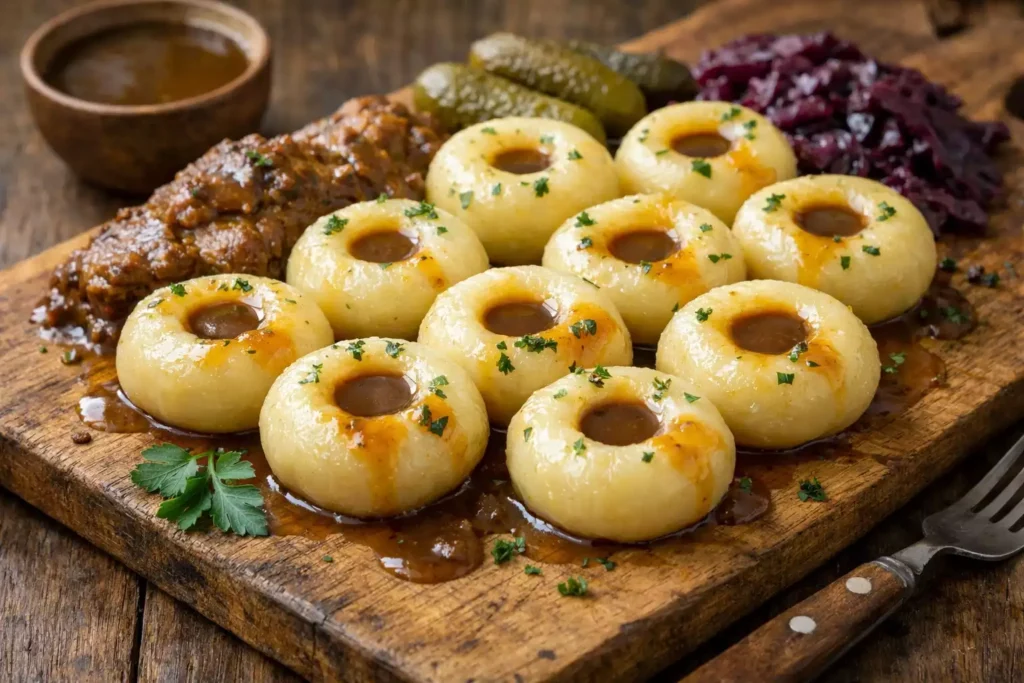
The hole isn’t decoration — it’s engineering. Every single kluski śląski is a tiny gravy boat, designed with a thumbprint indent that catches sauce and holds it like a little edible bowl. The first time I explained this to my American friends at a dinner party, they looked at me like I’d just revealed the secret of the universe. It’s not the secret of the universe. But it’s close.
Kluski śląskie (KLOO-skee SHLAWN-skee) are Silesian dumplings from the Śląsk region of southern Poland. If you know kopytka, these are their cooler cousin — same potato base, but instead of flour they use potato starch, which gives them a completely different texture. They’re springy, slightly translucent, and have a satisfying chewiness that’s almost bouncy. Think of it like the difference between bread and mochi. Both carbs, totally different experience.
My babcia was from Śląsk, and she made these every Sunday without fail. She’d sit at the kitchen table with a mountain of dough and just thumb-thumb-thumb through hundreds of dumplings while telling stories about the war, the neighbours, and which cousin had done something scandalous. I learned to make kluski śląskie not from a recipe but from sitting next to her and copying what her hands did. The recipe below is as close as I can get to writing down what she never needed written down.
Why Kluski Śląskie Have a Hole
This is the question everyone asks, and the answer is practical genius. The indent in the centre of each dumpling serves two purposes: it helps the dumpling cook evenly (the thinner centre cooks at the same rate as the thicker edges), and it creates a natural cup that catches gravy, sauce, or melted butter. You don’t need to pour sauce over these — you pick one up and the sauce is already inside, waiting for you. It’s the most elegant solution to the “not enough sauce on my dumpling” problem that humans have ever invented.
The indent also has a visual purpose — you can immediately tell kluski śląskie apart from kopytka or any other dumpling. They’re the ones that look like they were lovingly poked by a grandmother’s thumb. Because they were.
Ingredients
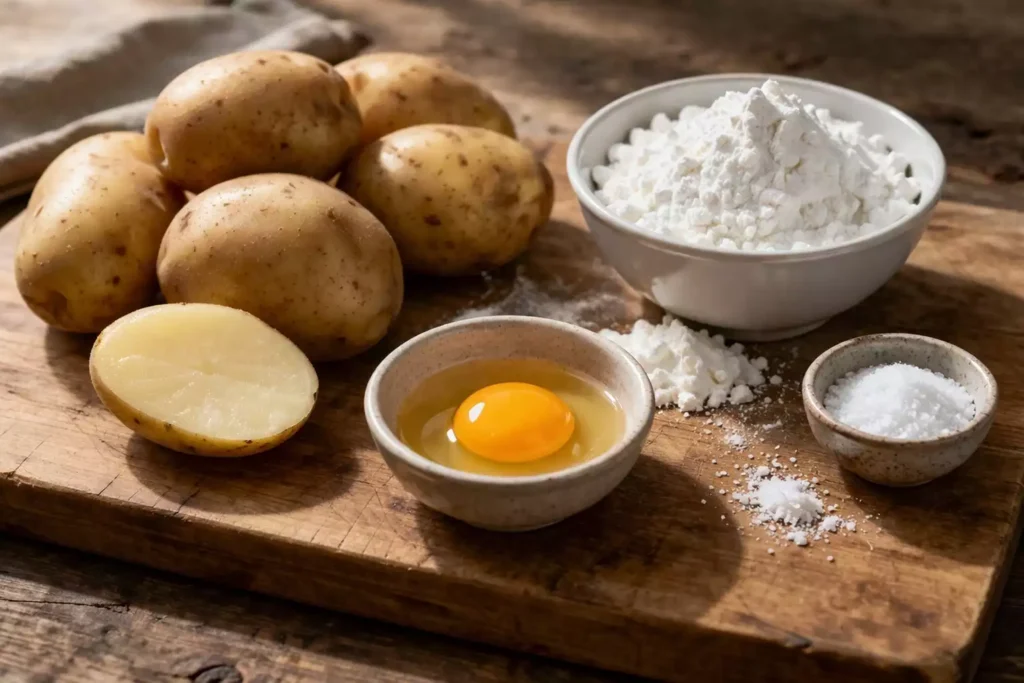
- • 2 pounds (900g) potatoes — starchy like Russets
- • 1 cup (130g) potato starch — not cornstarch, not flour. Potato starch specifically.
- • 1 large egg
- • 1 teaspoon salt
How to Make Kluski Śląskie
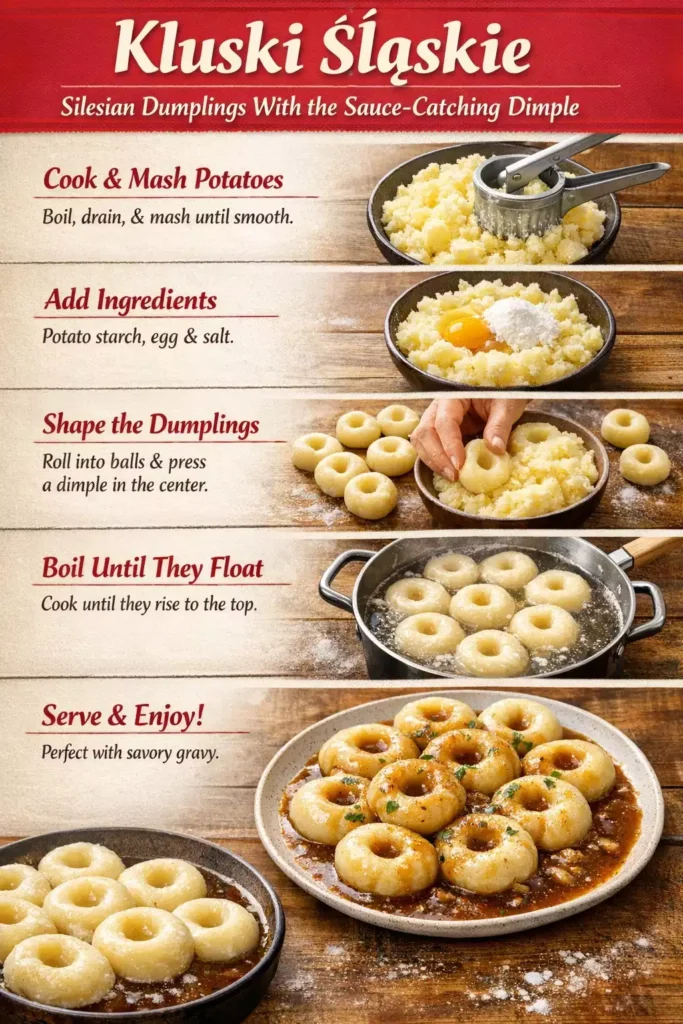
Cook and Mash the Potatoes
Peel the potatoes, cut into chunks, and boil in salted water until completely tender — about 18-20 minutes. Drain very well. Pass through a potato ricer if you have one — this is the best way to get a perfectly smooth mash with no lumps. Lumps in kluski śląskie are noticeable because the dough is more delicate than kopytka dough. Let the mashed potatoes cool to room temperature.
Important: the potatoes must be cool. If you add egg and starch to hot potatoes, the egg partially cooks and the starch gets gummy. Patience. Let them cool. Scroll your phone, yell at the kids to do homework, whatever you need to do for 20 minutes.
Make the Dough
Add the egg and salt to the cooled mashed potatoes. Mix well. Then add the potato starch gradually, kneading gently until a smooth dough forms. It should be soft, slightly elastic, and not sticky. If it’s sticky, add a bit more starch. If it’s dry and crumbly, your potatoes were too dry — add a tiny splash of water.
The dough should feel different from kopytka dough — stretchier, smoother, almost like playdough. That’s the potato starch doing its thing. It creates that signature springy, chewy texture once boiled.
Shape the Dumplings
Pull off a small piece of dough and roll it into a ball about the size of a walnut. Press your thumb into the centre to create the signature indent — push about halfway through, not all the way. The dumpling should look like a tiny bowl or a deflated ball. Place on a floured surface and repeat until all the dough is used.
This is the meditative part. Babcia could do about 10 per minute. I manage about 6. My kids “help” and produce abstract sculptures that we boil alongside the real ones because inclusivity matters.
Boil
Bring a large pot of salted water to a rolling boil. Drop dumplings in batches — about 15-20 at a time, don’t overcrowd. They’ll sink. When they float to the surface, cook for 1-2 more minutes, then remove with a slotted spoon. They’ll be slightly translucent and springy to the touch — that’s exactly right.
How to Serve Kluski Śląskie
The Classic: With Gravy (Sos)
In Silesia, kluski śląskie are traditionally served with meat gravy — thick, dark, rich gravy from roast pork or beef. The gravy pools in the thumb indents and every bite is a perfect ratio of dumpling to sauce. This is the Sunday dinner version that babcia made every single week. Alongside kotlet schabowy and a big bowl of mizeria, this is a complete Polish meal.
With Brown Butter and Breadcrumbs
The quick weeknight version. Brown some butter, toast breadcrumbs in it, toss the boiled kluski through. Same treatment as kopytka, equally delicious.
With Mushroom Sauce
Sautéed forest mushrooms with onion, cream, and fresh dill, poured over boiled kluski. This is the special occasion version — especially popular during Wigilia (Christmas Eve) when many Polish families eat meatless.
Kluski Śląskie vs. Kopytka
People mix these up constantly, so here’s the breakdown. Both are potato dumplings. Both are Polish. But they’re different in important ways:
• Flour vs. starch: Kopytka use wheat flour. Kluski śląskie use potato starch. This gives kluski a springier, chewier, more translucent texture.
• Shape: Kopytka are cut from a rope (like gnocchi). Kluski śląskie are rolled into balls with a thumb indent.
• Texture: Kopytka are denser and softer. Kluski śląskie are bouncier and chewier.
• Region: Kopytka are made all over Poland. Kluski śląskie are specifically from Silesia (Śląsk) and are a point of regional pride.
Which is better? That depends on which region your babcia was from. In our house, we make both and fight about it lovingly.
Tips
💡 Pro Tips
✓ Use potato starch, not flour. Flour makes kopytka. Potato starch makes kluski śląskie. They’re different dumplings. Using the wrong one gives you the wrong texture.
✓ Cool your potatoes completely. Hot potatoes + starch = gummy, sticky disaster. Room temperature is key.
✓ Don’t make the indent too deep. Push about halfway through. All the way through gives you a donut shape that falls apart in the water.
✓ Float test. When they float, give them 1-2 more minutes. Underdone kluski are starchy in the middle. Properly done ones are evenly springy throughout.
✓ Potato ricer is worth it. Even one lump creates a lumpy dumpling. A ricer guarantees smoothness.
How to Store
Cooked kluski keep in the fridge for 3-4 days. Reheat by pan-frying in butter — they develop a gorgeous golden crust while staying chewy inside. They freeze well for up to 3 months. Freeze them on a baking sheet first (so they don’t stick together), then transfer to a freezer bag. Cook from frozen by dropping into boiling water for 4-5 minutes.
Frequently Asked Questions
Where can I buy potato starch?
Most grocery stores carry it in the baking aisle — Bob’s Red Mill makes one that’s widely available. Asian grocery stores always have it. Polish delis definitely have it. Amazon has it. It’s not an exotic ingredient — you just might not have noticed it before.
Can I use cornstarch instead of potato starch?
Please don’t. The texture will be completely wrong — cornstarch makes a gluey, slippery dumpling that’s nothing like the real thing. Potato starch is what gives kluski śląskie their signature bounce. It’s worth finding.
Why are mine falling apart in the water?
Either the dough was too wet (not enough starch) or the water was at a violent boil instead of a gentle one. The boil should be rolling but not aggressive. Drop a test dumpling first — if it holds together, you’re good. If it disintegrates, knead in a bit more starch.
Kasia Polish Mom
Polish-born, Chicago-raised, feeding a family of six with babcia’s recipes and a global pantry. I grew up folding pierogi at my grandmother’s kitchen table and never stopped — 15+ years of cooking from scratch, one Sunday dinner at a time. Everything here is tested on four kids, a hungry husband, and the memory of a woman who never measured anything but always got it right.