


Kasia Polish Mom
Polish-born, Chicago-raised, feeding a family of six with babcia’s recipes and a global pantry. I grew up folding pierogi at my grandmother’s kitchen table and never stopped — 15+ years of cooking from scratch, one Sunday dinner at a time. Everything here is tested on four kids, a hungry husband, and the memory of a woman who never measured anything but always got it right.
Sernik Wielkanocny — The Baked Polish Cheesecake for Easter
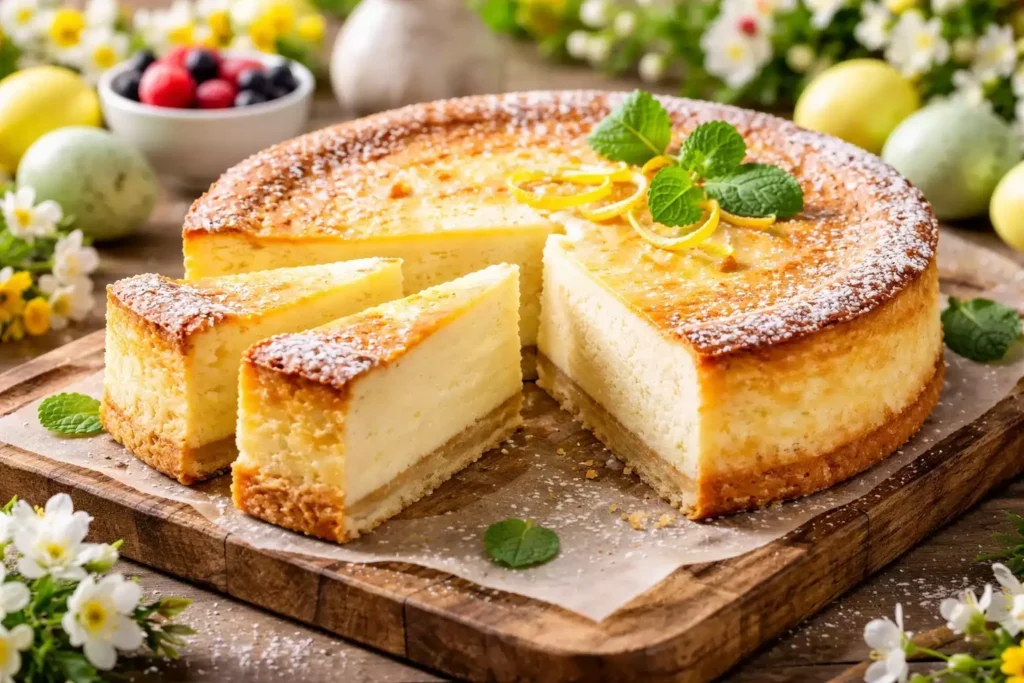
There are two camps of Polish cheesecake: the no-bake refrigerator sernik and the proper baked sernik. They are both excellent but they are completely different experiences. No-bake sernik is light, airy, sometimes set with gelatin, pleasant for a hot summer day. Baked sernik wielkanocny is something else entirely: dense, silky, slightly eggy in the best possible way, with a crumb that trembles when you slice it and a flavor that fills the entire Easter kitchen from the moment the oven heats up.
Easter demands the baked version. There is no debate about this. The baked sernik is the heavier, more serious cake, built from Polish twaróg — a fresh, acid-set cheese made from cow’s milk with a dry, slightly grainy texture that bakes completely differently from ricotta or cream cheese. Twaróg is not a substitute in this recipe. It is the recipe. Every other cheesecake in the world is a variation; Polish sernik made with twaróg is the original.
My babcia baked sernik in a springform tin lined with a thin pastry base. My aunt makes hers without the pastry, directly on the tin base. Both are correct. Both are beautiful. I include the pastry version here because the contrast of the crisp pastry against the silky filling is one of the great textural combinations in Polish baking.
Why This Baked Sernik Works
The twaróg must be processed before use. Grainy twaróg passed through a fine sieve or blended smooth produces a filling with a silky, cohesive texture. Unprocessed twaróg gives a grainy, slightly lumpy filling that bakes unevenly. This is the most commonly skipped step and the source of most sernik disappointments. Five minutes of processing transforms the texture of the final cake completely.
Low and slow baking in a water bath prevents the cheesecake from cracking and keeps the filling uniformly silky throughout. High-temperature baking produces a set, slightly rubbery result that is fine for American-style cheesecake but wrong for the trembling delicacy of a properly baked Polish sernik.
Ingredients
Put ingredients on wooden board, don’t put ready food just ingredients. Don’t include any text over the image[/aiccp-img]
For the Pastry Base
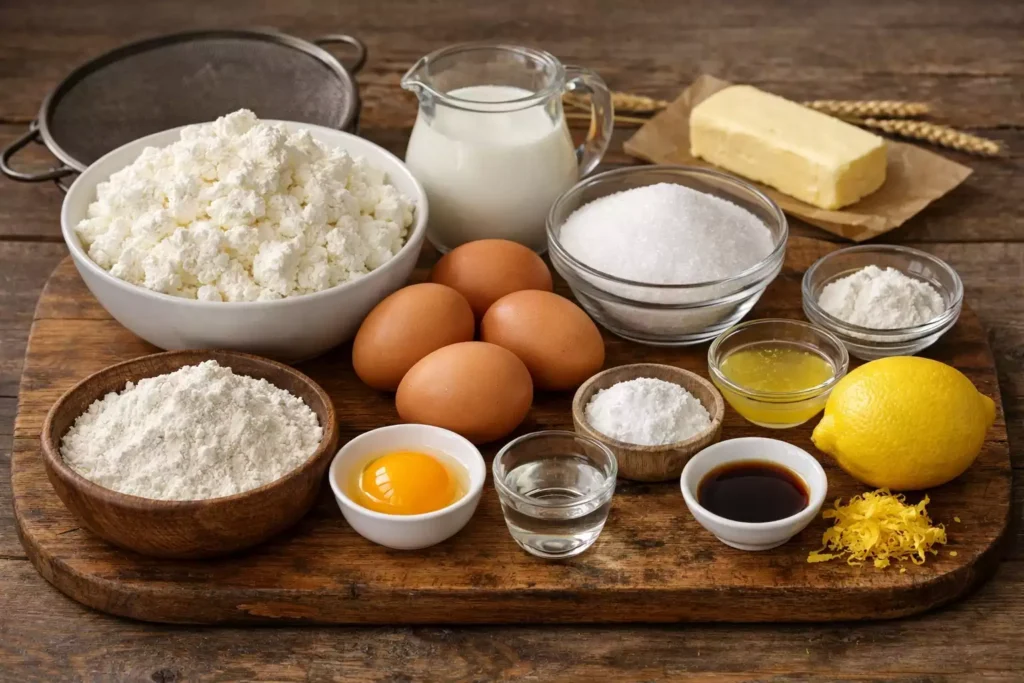
- 200g (1.6 cups) plain flour
- 80g (6 tbsp) cold unsalted butter
- 50g (4 tbsp) powdered sugar
- 1 egg yolk
- 2 tbsp cold water
For the Cheesecake Filling
- 1kg (2.2 lbs) Polish twaróg (tłusty — full-fat), passed through a fine sieve
- 200g (1 cup) caster sugar
- 5 large eggs, separated
- 100ml (½ cup) heavy cream
- 1 tbsp potato starch or plain flour
- 1 tsp vanilla extract
- Zest of 1 lemon
- 50g (3.5 tbsp) unsalted butter, melted and cooled
How to Make It
1
1Make and Blind-Bake the Pastry Base
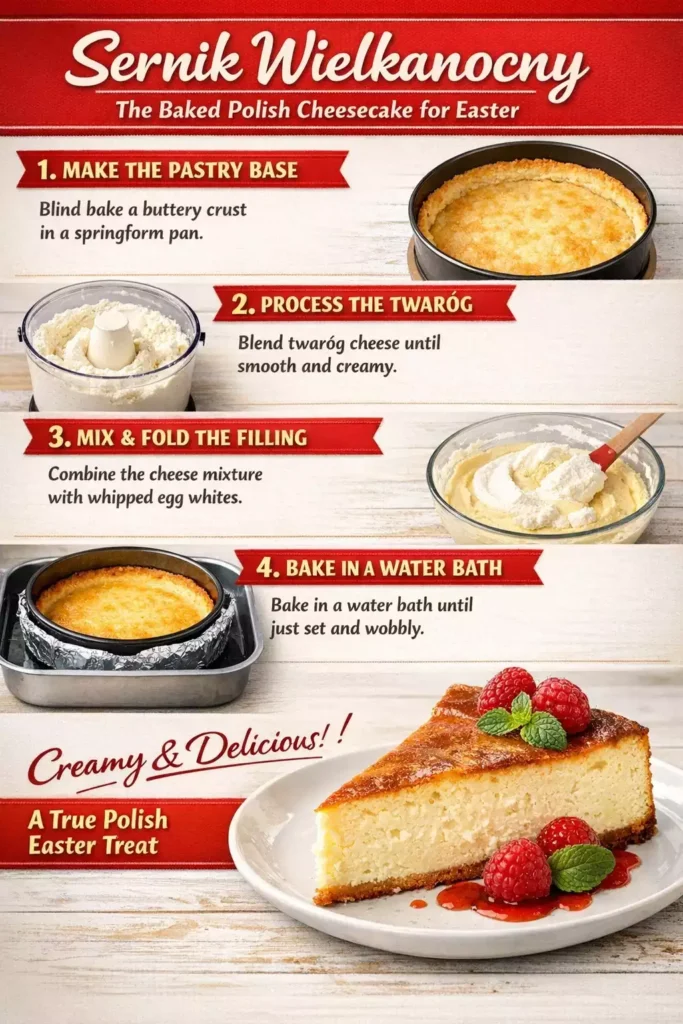
Rub butter into flour and powdered sugar until it resembles breadcrumbs. Add the egg yolk and water, bring together quickly into a dough. Press into a thin layer on the base of a greased 26cm springform tin (not up the sides). Prick with a fork. Bake at 180°C / 355°F for 15–18 minutes until just golden. Cool completely before adding filling. A warm pastry base will partially cook the filling at the edges and create an uneven bake.
2
2Process the Twaróg
Pass the full-fat twaróg through a fine-mesh sieve or blend in a food processor until completely smooth. This is not optional. The difference in final texture between processed and unprocessed twaróg is visible and significant. Processed twaróg blends into a silky cream. Unprocessed twaróg stays grainy regardless of how long you bake it.
3
3Build the Filling
Beat the egg yolks with the sugar until pale. Add the processed twaróg, cream, potato starch, vanilla, lemon zest, and melted butter. Mix until smooth. In a separate, clean bowl, whisk the egg whites to stiff peaks. Fold gently into the cheese mixture in three additions, preserving as much air as possible. The folded filling should be light and mousse-like.
4
4Bake in a Water Bath
Wrap the outside of the springform tin tightly in two layers of heavy-duty foil. Pour the filling over the cooled pastry base. Place the tin in a larger roasting dish and pour hot water around it to come halfway up the sides. Bake at 160°C / 320°F for 60–70 minutes. The sernik is done when the edges are set but the center still has a very slight wobble. It will firm up as it cools.
5
5Cool Slowly
Turn off the oven. Leave the sernik inside with the door slightly ajar for 1 hour. Then remove and cool at room temperature for another hour. Then refrigerate for at least 4 hours, ideally overnight. This gradual cooling prevents the dramatic cracking that happens when a hot cheesecake meets cold air suddenly. Patience here equals a perfect surface.
Sernik Tips That Prevent Easter Cheesecake Disaster
Find Polish twaróg. This recipe requires Polish twaróg (tłusty — the full-fat kind). Cream cheese produces a denser, American-style cheesecake. Ricotta is too wet and mild. Twaróg has a specific dry tanginess that no other cheese replicates. Polish delis sell it fresh or in a block. It is worth sourcing properly.
The water bath is the anti-crack device. Without it, the outer edge of the cheesecake bakes faster than the center, the differential shrinkage causes cracks, and you have a cracked Easter sernik which is perfectly delicious but cosmetically sad. Use the water bath. It is not complicated and it works.
The wobble test. A properly baked sernik will wobble in the center like a very firm jelly when gently shaken. It should not be liquid, but it should not be completely still either. It sets up as it cools. Trust the wobble. Do not overbake chasing a firm center.
Chill overnight before serving. Sernik sliced warm or at room temperature collapses into a pleasant puddle. Sernik chilled overnight stands tall, slices cleanly, and has a texture that is nothing short of elegant. Make it the day before Easter.
Sernik Wielkanocny at the Easter Table
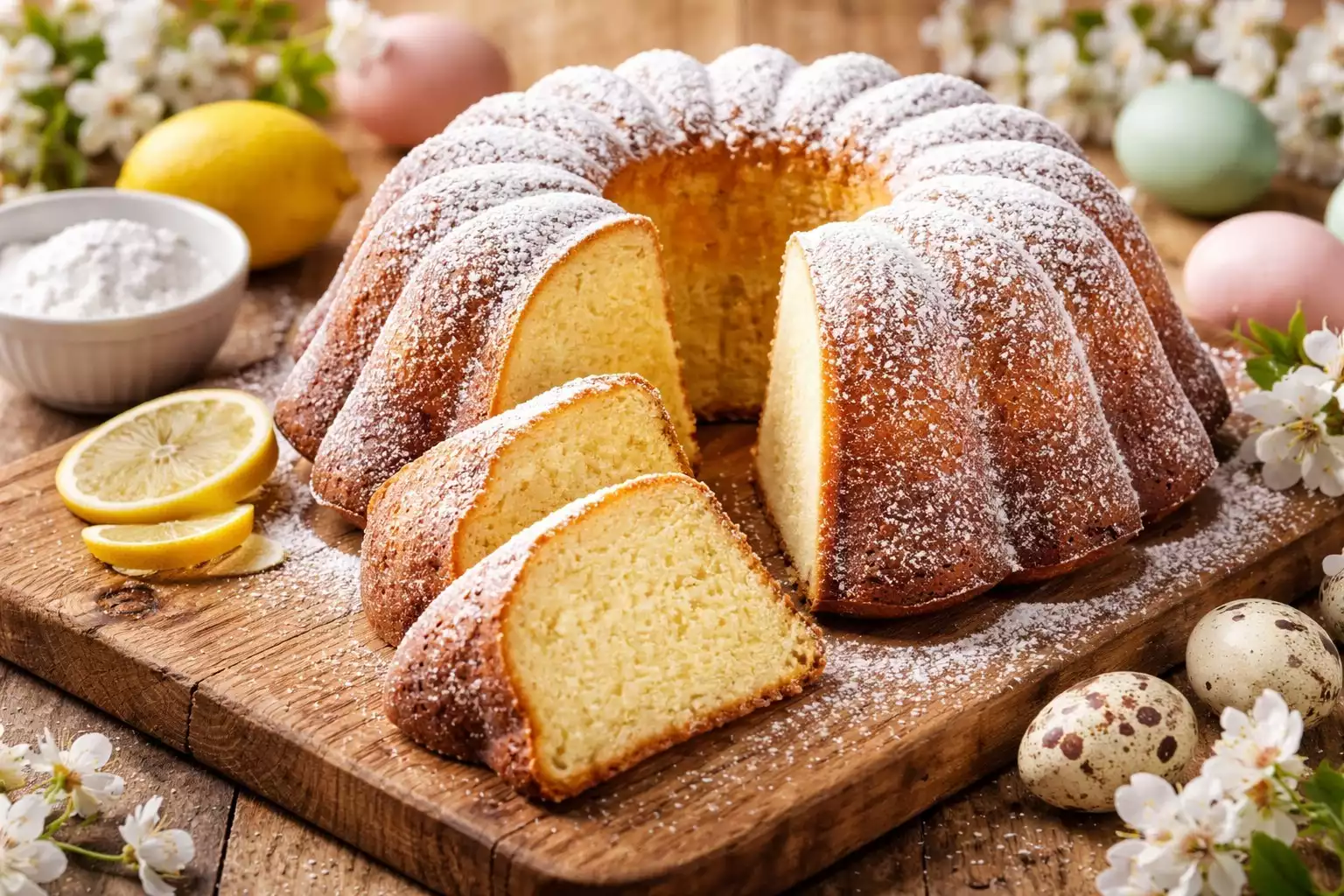
Baked sernik takes the dessert position at the Easter table alongside baba wielkanocna and babka piaskowa. Where the babas are sliced and spread with butter, the sernik is plated individually in slices — it is a more formal dessert despite being a completely casual, family recipe. A thick slice of cold sernik with a drizzle of fruit sauce or simply plain is one of the most satisfying ways to end the Easter feast.
The distinction between wielkanocny (Easter) sernik and any other sernik is mostly ceremonial — it is baked specifically for Easter and eaten specifically at Easter, which is all the distinction it needs. The no-bake refrigerator sernik takes the rest of the year.
Variations Worth Trying
With raisins. Fold 100g of rum-soaked raisins into the filling before baking. They sink into the sernik during baking and produce little pockets of sweet, boozy fruit throughout every slice. Traditional in some Polish households and genuinely excellent.
Sernik na kruchym spodzie (with full shortcrust shell). Instead of just a pastry base, line the sides of the tin with shortcrust as well. This gives you a fully pastry-enclosed cheesecake that holds its shape for transportation and slicing at the table. More impressive presentation, same delicious filling.
With sour cherry topping. Top the cooled sernik with a sour cherry compote (wiśnie in syrup) that has been thickened with a little cornstarch. The tartness of the cherries against the rich, slightly sweet filling is a very Polish flavor combination.
Storage
Baked sernik keeps refrigerated for up to 5 days, covered with cling film. It is arguably at its absolute best on day 2 or 3, after the flavors have had time to fully develop. It can be frozen in slices for up to 2 months — wrap individually and defrost in the refrigerator overnight rather than at room temperature.
FAQ
Can I substitute cream cheese for twaróg?
You can make a cream cheese sernik that is delicious — but it will taste like New York cheesecake, not Polish sernik. The tang and texture of twaróg are fundamentally different from cream cheese. For an authentic Easter sernik, source the twaróg. For a good cheesecake that does not pretend to be Polish, cream cheese works.
My sernik cracked despite using the water bath. Why?
Most likely the oven temperature was too high, the baking time was too long, or the cooling was too rapid. Check your oven temperature with a thermometer — many ovens run hotter than indicated. Cool the sernik inside the turned-off oven for a full hour before moving it. Cracks happen even with best practices; they are cosmetic only.
Is twaróg the same as quark?
Very similar. Polish twaróg and German quark are both acid-set fresh cow’s milk cheeses. German quark has a slightly higher moisture content and milder flavor. In a pinch, well-drained full-fat quark can substitute for twaróg — drain it overnight through a cheesecloth to reduce moisture and the result will be very close. Polish twaróg has a slightly grainier, drier texture and a more pronounced lactic tang.

Kasia Polish Mom
Polish-born, Chicago-raised, feeding a family of six with babcia’s recipes and a global pantry. I grew up folding pierogi at my grandmother’s kitchen table and never stopped — 15+ years of cooking from scratch, one Sunday dinner at a time. Everything here is tested on four kids, a hungry husband, and the memory of a woman who never measured anything but always got it right.